How to Measure Whether Sleep Meditation Is Actually Helping Your Anxiety
If you want to measure sleep meditation results, you need something painfully unglamorous first: a baseline. Most people try a meditation app for three nights, feel slightly different, then either declare victory or give up. That tells you almost nothing. Anxiety moves around. Sleep moves around. One decent night does not mean the practice is working, and one bad night does not mean it failed.
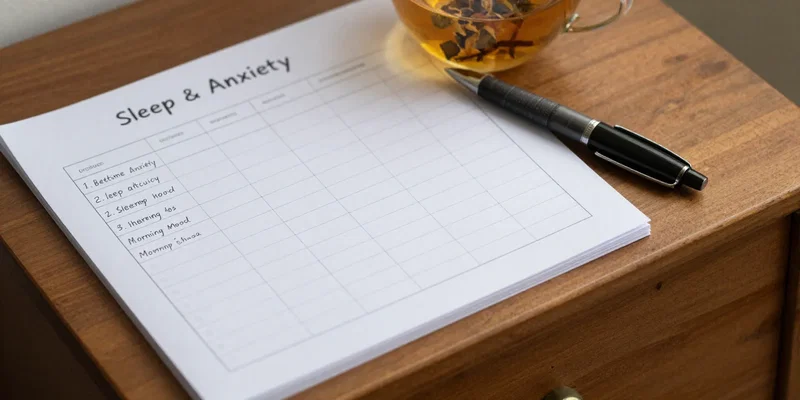
Before changing anything, track your normal pattern for at least 5 to 7 nights. Keep it simple. Rate your anxiety at bedtime from 0 to 10. Rate it again when you wake up. Write down how long you think it took to fall asleep, how many times you woke up, and how rested you felt in the morning. That gives you a practical sleep quality check, not a vague memory. If your usual bedtime habit includes doomscrolling, late snacks, wine, or work emails at 11:30 p.m., note that too. Sleep meditation does not happen in a vacuum, and neither does anxiety.
Track the Right Signals Instead of Chasing a Perfect Night
Here’s where people get tripped up: they use the wrong scoreboard. They ask, “Did I sleep perfectly?” That’s too blunt. Sleep meditation often helps in smaller, earlier ways before your nights become obviously better. Maybe you still woke up twice, but you fell back asleep faster. Maybe your mind was still busy, but it felt less catastrophic. Maybe bedtime stopped feeling like a nightly fight.
For useful anxiety tracking, watch five signals: how tense you feel before bed, how long it takes to settle, how often you wake during the night, how agitated you feel when you do wake up, and how wrecked or steady you feel the next morning. If you want one clean scoring system, rate each from 1 to 5 and total it nightly. Over two weeks, patterns show up fast. You’re not looking for magic. You’re looking for movement. If your pre-bed anxiety drops from an 8 to a 5 most nights, that matters even if your sleep is not suddenly flawless. A calmer nervous system at bedtime is a real result, not a consolation prize.
Give the Meditation a Fair Test by Keeping the Rest of Your Routine Stable
If you change three things at once, you won’t know what helped. This is the part nobody loves, but it matters. To tell whether sleep meditation is helping your anxiety, keep the rest of your bedtime habit as boringly consistent as possible for 10 to 14 days. Same rough bedtime. Similar caffeine timing. Similar alcohol intake, preferably none close to bed. Same room temperature. Same lights-out routine.
Actually, this is why some people think meditation “doesn’t work” when the test itself is a mess. They meditate one night after a calm evening, then skip it the next night after two glasses of wine, a late workout, and an argument with their partner. That’s not a comparison. It’s noise. A fair test means using the same meditation style for long enough to judge it. Don’t bounce between ten-minute body scan, sleep stories, binaural beats, and random breathwork every night unless you’re deliberately testing formats. Pick one approach and repeat it. If after two consistent weeks your anxiety tracking shows no shift at bedtime, no easier settle-down, and no improvement in how keyed up you feel during night wakings, then you have real data. Not a hunch.
Know What Improvement Usually Looks Like in Real Life
A lot of people miss improvement because they expect the wrong version of it. Sleep meditation usually does not erase anxious thoughts on command. More often, it changes your relationship to them. The thoughts still show up, but they lose some bite. You stop following every thread. Your body unclenches sooner. You spend less time panicking about being awake. That counts.
Here’s a practical way to check whether it’s working: compare Week 1 to Week 2 and ask specific questions. Am I dreading bedtime less? Am I recovering faster when my mind starts spinning? When I wake at 3 a.m., do I spiral for 45 minutes or settle in 15? Is the next day a complete write-off, or just slightly rough? Those are meaningful markers. A good sleep quality check is not only about hours slept. It is also about how much struggle happened around the sleep. If meditation reduces the struggle, it may be helping your anxiety before it dramatically changes your total sleep time.
Watch for Red Flags That Mean the Practice Needs Adjusting
Not every sleep meditation is a fit. Some voices are too chirpy. Some scripts are too long. Some breathing exercises make anxious people more aware of their heartbeat, which can backfire. If you notice that the practice reliably makes you more alert, more frustrated, or weirdly performance-focused about falling asleep, don’t force it just because meditation is supposed to be calming. Your nervous system does not care what’s trendy.
There are a few red flags worth taking seriously. If your bedtime anxiety rises as soon as you press play, if you’re getting irritated by the instructions night after night, or if you start treating meditation like a test you have to pass, the setup needs work. Try a shorter track, less talking, slower pacing, or a different format like body scan instead of breath counting. And if your sleep problems are getting worse, or your anxiety is intense enough that you’re having panic symptoms, intrusive thoughts, or major daytime impairment, this has moved beyond a self-experiment. Meditation can be useful, but it is not a substitute for proper treatment when anxiety is really running the show.
Use a Two-Week Review So You Can Decide What to Keep, Change, or Drop
After 14 nights, sit down and review the data like a mildly skeptical adult. Not like a desperate person looking for proof that the app was worth the subscription. Look for trends, averages, and friction points. Did your bedtime anxiety score come down? Did sleep latency improve even a little? Are you waking up less activated? Is the bedtime habit easier to stick to than your old routine? If the answers are mostly yes, keep going. You do not need perfection to justify a practice that is clearly helping.
If the results are mixed, make one change and test again for another week. Maybe the meditation is fine, but the timing is wrong. Maybe listening in bed keeps you too mentally engaged, while doing it 20 minutes earlier works better. Maybe guided tracks annoy you, but nonverbal audio helps. The point of measuring is not to prove devotion to sleep meditation. It is to find out whether this tool reduces anxiety in a way you can actually feel and repeat. If your notes show better settling, less nighttime spiraling, and a steadier morning mood, that’s your answer.